If you have just been diagnosed with Klinefelter Syndrome, you are probably looking for clear, honest answers. This article explains what Klinefelter Syndrome is in plain language – what causes it, how it affects your body, and what treatment looks like in India. By the end, you will have a solid understanding of your diagnosis and a clear sense of what to do next.
What is Klinefelter Syndrome?
Klinefelter Syndrome is a genetic condition where males are born with an extra X chromosome. The typical male chromosome pattern is 46,XY – 46 chromosomes in total, with one X and one Y. Men with Klinefelter Syndrome have 47,XXY – one extra X chromosome in every cell of their body.
The condition was first described by American physician Dr. Harry Klinefelter in 1942, which is how it got its name. It is worth being clear about one thing: Klinefelter Syndrome is not a disease. It is a chromosomal variation you were born with. Having an extra X chromosome does not change the fact that you are male. You have a Y chromosome, male anatomy, and a male identity. Your genetic blueprint is simply a little different from most men.
Klinefelter Syndrome is one of the most common chromosomal conditions in the world, affecting approximately 1 in 500 to 1,000 males[2]. In India, that translates to an estimated 700,000 to 1,400,000 men living with the condition right now. The vast majority have no idea, because only around 5 to 10 percent of men with Klinefelter Syndrome are ever diagnosed[2]. Many live their entire lives without knowing, because symptoms can be mild or easy to overlook.
The condition is manageable with proper treatment, and most men with Klinefelter Syndrome live full, healthy lives. It is not life-threatening, and you are far from alone.
What Causes Klinefelter Syndrome?
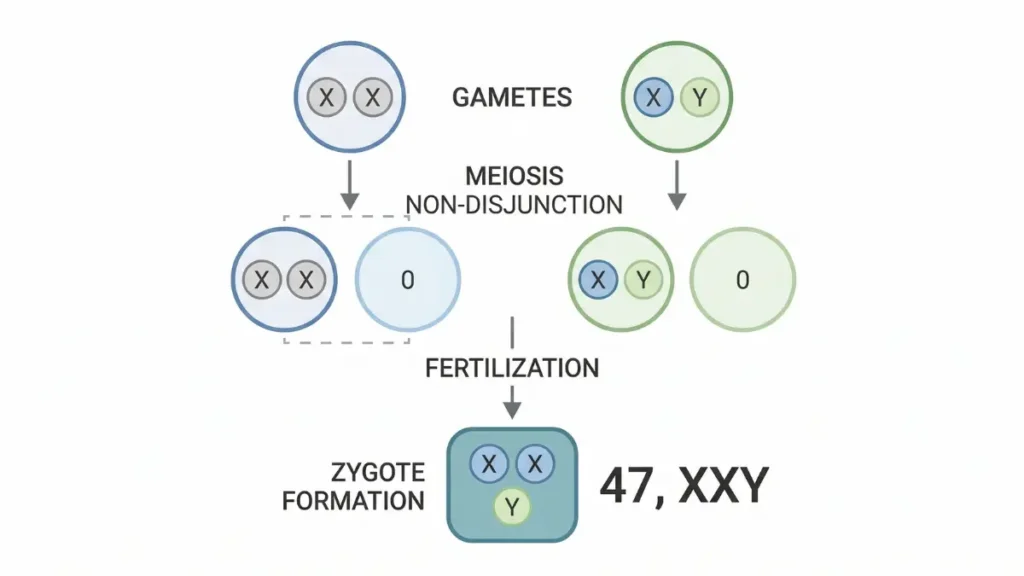
Klinefelter Syndrome is caused by a random genetic event that occurs during conception. When sperm and eggs are formed, chromosomes are supposed to separate evenly. Sometimes this process does not work perfectly – a mistake called nondisjunction occurs, and an extra X chromosome ends up in either the sperm or the egg[1]. When that sperm or egg combines at conception, the result is an embryo with XXY chromosomes instead of XY.
This is entirely random. It is not something anyone could have prevented or predicted, and it does not run in families[1]. Your children will not have an increased risk of Klinefelter Syndrome. Nothing about your lifestyle, your health, or your choices caused this. Nothing your parents did or did not do during pregnancy caused it either. The only known factor associated with a slightly higher occurrence is maternal age over 35[3], though the condition affects men born to mothers of all ages, across all ethnicities, nationalities, and socioeconomic backgrounds equally.
There was nothing that could have been done differently. This is simply one of nature’s variations that happens randomly during human development.
How Does Klinefelter Syndrome Affect You?
The primary effect of Klinefelter Syndrome is lower testosterone production. The extra X chromosome affects how the testes develop and function, which means they produce less testosterone than is typical[1]. This lower testosterone level is the root cause of most symptoms you may experience.
Physical effects vary considerably from one man to the next. Some men have very mild symptoms they barely notice. Others experience more pronounced changes. Common effects include lower energy and fatigue, reduced muscle mass, increased body fat particularly around the waist and chest, sparse or patchy facial and body hair, and smaller testes. Around 50 percent of men with Klinefelter Syndrome develop some degree of gynecomastia – breast tissue growth – which can range from barely noticeable to more significant[4]. Many men with the condition are also taller than average, often with longer arms and legs relative to their torso.
Fertility is the other major area of concern. Most men with Klinefelter Syndrome produce very little sperm or none at all naturally, because the extra X chromosome disrupts normal sperm production in the testes[1]. This does not mean fatherhood is impossible. Medical options exist, including micro-TESE – a surgical procedure that can retrieve sperm directly from the testes[2] – as well as donor sperm and adoption. Many men with Klinefelter Syndrome go on to have families. There is a detailed Fertility Options Guide on this site that walks through every available path, including costs and success rates in India.
It is also worth knowing about a variant called mosaic Klinefelter Syndrome, where only some cells carry the XXY pattern while others have the typical XY pattern. Men with mosaic KS often experience milder symptoms and sometimes have better fertility potential than those with the classic form[5].
Many men are not diagnosed until adulthood – often during investigations for infertility – precisely because their symptoms were subtle enough not to raise concern earlier. If that is your situation, it is more common than you might think.
The encouraging reality is that most of these effects are treatable. With proper testosterone replacement therapy, the majority of men with Klinefelter Syndrome see meaningful improvements in energy, muscle mass, body composition, mood, and overall quality of life. For a detailed breakdown of symptoms by life stage and how they present in Indian men, see the Symptoms and Diagnosis Guide.
Treatment for Klinefelter Syndrome in India
The primary treatment for Klinefelter Syndrome is Testosterone Replacement Therapy, commonly called TRT. Since the core issue is lower testosterone production, replacing that testosterone addresses most symptoms effectively.
Most men who start TRT report meaningful improvements in energy levels, muscle mass and strength, bone density, mood and mental clarity, body composition, and sexual function[1]. These are not minor quality-of-life adjustments. For many men, starting TRT is the point at which they begin to feel genuinely well for the first time.
The good news for Indian men is that TRT is both widely available and affordable here. Injectable testosterone is the most commonly used form in India and costs approximately ₹500 to ₹800 per month. It is administered every two to three weeks, either by a doctor or self-administered at home once you are comfortable with the process. Testosterone gel is also available and offers the convenience of daily application without injections, though it costs considerably more at around ₹2,000 to ₹3,000 per month. Patches are another option, though less commonly prescribed in India.
Alongside the medication itself, you will need monitoring blood tests twice a year to check your testosterone levels and overall health. These typically cost ₹2,000 to ₹4,000 per test at a private lab, and less at government facilities. Including medication, monitoring, and doctor consultations, most men in India manage their Klinefelter Syndrome for approximately ₹12,000 to ₹25,000 per year on injectable testosterone. If you choose gel, expect annual costs closer to ₹25,000 to ₹35,000.
TRT is managed by an endocrinologist – a hormone specialist – not a general physician. If you have not yet seen one, finding the right doctor is your most important first step. The Finding a KS Doctor in India guide covers what to look for and where to start in major Indian cities.
Beyond TRT, other treatments may be relevant depending on your individual situation. If gynecomastia is causing significant physical or psychological discomfort, surgical removal is an option available at most large private hospitals in India. Bone health support through Vitamin D, calcium, and weight-bearing exercise is recommended for most men with the condition, as low testosterone over time can affect bone density[1]. Fertility treatment is a separate pathway that requires its own planning and specialist involvement. And if the diagnosis has brought up anxiety, low mood, or adjustment difficulties – which is entirely normal – speaking to a psychologist or counsellor can make a significant difference. Mental health support remains underutilised in India, but it is available in most cities and increasingly online.
The long-term outlook with treatment is straightforward. With proper testosterone replacement and regular monitoring, most men with Klinefelter Syndrome maintain good health, live normal lifespans, and lead full lives – in their careers, their relationships, and their families. This is one of the more manageable hormonal conditions, and treatment in India is both accessible and effective.
For a full breakdown of every TRT option available in India, how to start treatment, what monitoring involves, and how to manage side effects, see the Complete TRT Guide for India.
Common Questions
Can Klinefelter Syndrome be cured?
There is no cure for Klinefelter Syndrome in the sense that the extra X chromosome is present in every cell of your body from conception and cannot be removed or changed. But saying there is no cure is not the same as saying you are stuck with symptoms.
The symptoms are highly treatable. Testosterone replacement therapy addresses the vast majority of issues that men with Klinefelter Syndrome face. With treatment, most men feel genuinely well – good energy, normal muscle mass, healthy mood, active sex life. Think of it this way: someone with type 1 diabetes cannot cure their pancreas, but with insulin they live a completely normal life. The same logic applies here. Treatment does not fix the chromosome, but it addresses what the chromosome affects.
Can I live a normal life?
Yes. With testosterone replacement therapy, the vast majority of men with Klinefelter Syndrome maintain normal energy levels, pursue any career they choose, have relationships, get married, have children through various options, stay physically active, and enjoy good quality of life. Klinefelter Syndrome is one part of who you are. It is not your whole identity, and it does not define what you are capable of.
Will I be able to have children?
Natural conception is uncommon for men with Klinefelter Syndrome because most produce very little or no sperm naturally. However, this does not mean fatherhood is out of reach. A surgical procedure called micro-TESE can retrieve sperm directly from the testes in around 30 to 50 percent of cases[2], which can then be used with IVF. Donor sperm and adoption are also valid paths that many men with KS choose. The Fertility Options Guide covers every available route in detail, including costs and success rates at Indian fertility clinics.
Is this my fault – or my parents’ fault?
No. Klinefelter Syndrome is caused by a random chromosomal event during conception that no one could have predicted or prevented. Nothing you did caused it. Nothing your parents did caused it. It is not inherited, it does not run in families, and there is no lifestyle factor, dietary choice, or health decision that leads to it. It is one of nature’s random variations, and it happens across all ethnicities, backgrounds, and family histories equally.
For answers to more detailed questions about treatment, costs, finding a doctor, insurance, and fertility specifics, see the Klinefelter Syndrome FAQ.
What to Do Next
If you have just been diagnosed, the most important thing to know is that you do not need to figure everything out today. Here are the immediate steps that matter most.
Start by finding an endocrinologist – a hormone specialist – in your city. This is the doctor who will manage your Klinefelter Syndrome long term. A general physician can refer you, or you can look for one directly at a large private hospital or government medical college in your area. The Finding a KS Doctor in India guide has practical advice on what to look for and what questions to ask at your first appointment.
Once you have an appointment booked, your endocrinologist will order baseline blood tests to check your testosterone and hormone levels, along with a general metabolic panel. Understanding what these tests measure and what to expect from the process will help you feel more prepared. The Tests and Lab Costs in India guide covers exactly this, including typical costs at private and government labs across Indian cities.
From there, take some time to understand your treatment options before your first consultation. Reading the Complete TRT Guide for India and the Fertility Options Guide before you see your doctor means you can ask better questions and make more informed decisions. Knowledge genuinely reduces anxiety here.
Most men see an endocrinologist within two to four weeks of diagnosis and begin treatment within two to three months if it is indicated. There is no rush. Take the time you need to process the information and move at a pace that feels right for you.
1. Groth KA, Skakkebæk A, Høst C, Gravholt CH, Bojesen A. Klinefelter Syndrome – A Clinical Update. Journal of Clinical Endocrinology and Metabolism. 2013;98(1):20-30. https://pubmed.ncbi.nlm.nih.gov/23118427/
2. Gravholt CH, Chang S, Wallentin M, Fedder J, Moore P, Skakkebæk A. Klinefelter Syndrome – Integrating Genetics, Neuropsychology and Endocrinology. Endocrine Reviews. 2018;39(4):389-423. https://pubmed.ncbi.nlm.nih.gov/29438472/
3. Bojesen A, Juul S, Gravholt CH. Prenatal and postnatal prevalence of Klinefelter syndrome: a national registry study. Journal of Clinical Endocrinology and Metabolism. 2003;88(2):622-626.
4. Lanfranco F, Kamischke A, Zitzmann M, Nieschlag E. Klinefelter’s syndrome. The Lancet. 2004;364(9430):273-283.
5. Wikström AM, Dunkel L. Klinefelter syndrome. Best Practice and Research Clinical Endocrinology and Metabolism. 2011;25(2):239-250.
6. Endocrine Society of India – Klinefelter Syndrome Indian Registry. endocrinesocietyindia.org/klinefelter_syndrome_indian_registry.php