

A Klinefelter Syndrome diagnosis can feel overwhelming. One moment you are living your normal life, and the next you are looking at a karyotype report showing 47,XXY – a chromosome pattern you have never heard of before. Questions flood in immediately. What does this mean? What do I do now? Is my health at risk? Can I still have children?
This reaction is completely normal. Most men diagnosed with Klinefelter Syndrome – especially adults diagnosed during fertility investigations – feel a mix of confusion, anxiety, and sometimes relief that they finally have answers for things that have felt wrong for years.
This guide gives you a clear, week-by-week action plan for the first 90 days after diagnosis. No overwhelm, no medical jargon, just practical steps in order with India-specific costs and resources. Follow this plan, and by day 90 you will have a solid understanding of your condition, a qualified doctor managing your care, a treatment plan in place, and a clear path forward.
Why the First 90 Days Matter
The first three months after diagnosis set the foundation for everything that follows. The decisions you make now – which doctor to see, whether to start treatment, what to do about fertility – shape the next several years of your health and wellbeing.
The good news is that you do not need to figure everything out at once. Klinefelter Syndrome is manageable. Millions of men worldwide live full, healthy lives with 47,XXY chromosomes[1]. The key is taking the right steps in the right order without rushing or skipping stages.
This plan breaks 90 days into four clear phases. Each phase builds on the previous one. If you are feeling overwhelmed right now, just focus on Week 1. The rest will follow naturally.
Before You Start – What You Need to Know
Three things are important to understand before you begin working through this plan.
First, Klinefelter Syndrome is not a medical emergency. You do not need to rush to a hospital today. Most men with KS go years, sometimes decades, without diagnosis and without serious immediate harm. You have time to research properly, find the right doctor, and make informed decisions rather than rushed ones.
Second, your fertility timeline matters, but do not panic. If having biological children is important to you, acting within the first few weeks to months is valuable – but not because fertility disappears overnight. It is because starting testosterone replacement therapy later will suppress whatever remaining sperm production exists. Discussing fertility with your doctor early keeps your options open. This is important but not an immediate crisis.
Third, you are not alone in this. Klinefelter Syndrome affects approximately 1 in 500 to 1,000 males[2]. In India, that translates to an estimated 700,000 to 1.4 million men, the vast majority of them undiagnosed. You are joining a large community of men navigating this same journey, even if most of them remain invisible.
Phase 1 – Understanding (Days 1 to 7)
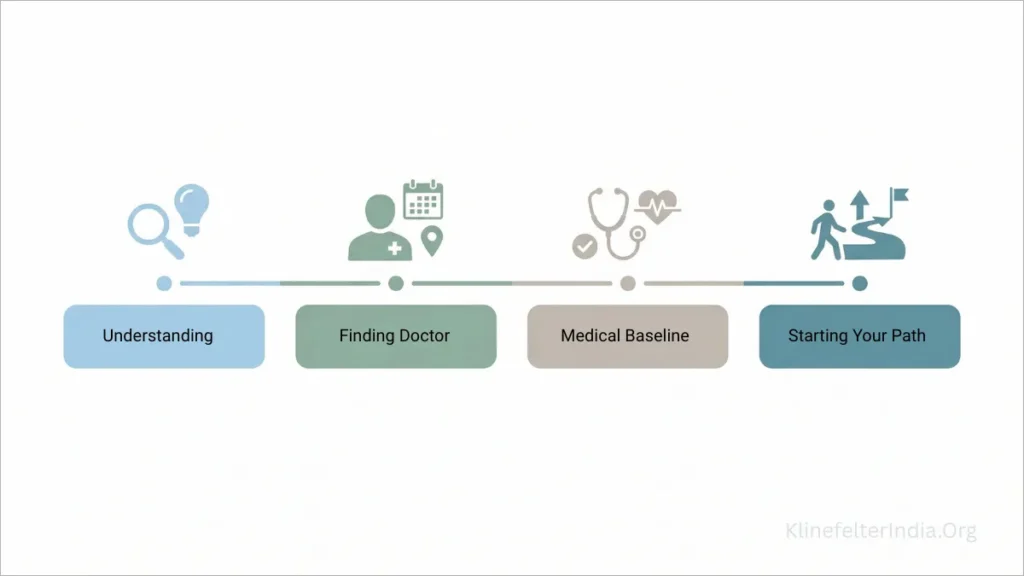
The first week is about understanding what Klinefelter Syndrome actually means for you – not just medically, but emotionally as well.
Days 1 to 2 – Process the Diagnosis
Give yourself permission to feel whatever you are feeling. Shock, confusion, sadness, anger, relief – all of these are normal reactions to a life-changing diagnosis. You do not need to have everything figured out immediately, and you do not need to make any decisions yet. Just sit with the information for a day or two.
Talk to someone you trust if you are ready to. This could be your partner, a close friend, or a family member. You do not need to explain everything in detail right away. Even saying “I received some health news and I am still processing it” is enough to open the door to support.
Days 3 to 5 – Learn the Basics
Read the foundational articles to understand what Klinefelter Syndrome actually means. Start with the What is Klinefelter Syndrome article, which covers what the condition is, what it is not, and what it means for your body. Then read the Klinefelter Syndrome Symptoms and Diagnosis article, which helps you understand which symptoms are connected to KS and which are not.
What you are building here is a calm, factual understanding of your condition. Not every concerning symptom you find online will apply to you. Many men with KS have mild symptoms and live very normal lives. The goal of these first few days is to replace panic with accurate information.
Days 6 to 7 – Make Your Decision List
Write down the questions and decisions that lie ahead of you. A simple written list helps reduce the mental chaos. Do you want biological children someday? Do you have symptoms that are affecting your daily life right now? Do you have a general physician you trust who can give you a referral? What is your realistic budget for initial consultations and tests?
Keep this list. You will bring it to your first doctor appointment and use it to guide your questions. Writing things down makes the path ahead feel more manageable.
Phase 2 – Finding Your Doctor (Days 8 to 21)
Week 2 – Identify and Screen Doctors
Finding the right doctor is the single most important action in the first 90 days. Everything else – tests, treatment, fertility decisions – flows from having a qualified doctor who understands Klinefelter Syndrome.
The type of doctor you need is an endocrinologist, a hormone specialist. If fertility is your primary concern, an andrologist – a male reproductive specialist – is ideal, though they are less common and mainly found in fertility clinics in major cities.
To find potential doctors, start by searching hospital websites for endocrinology departments in your city. Doctor platforms such as Practo or Lybrate allow you to filter by specialty. Ask your general physician for a referral. Call clinics directly and ask whether the doctor treats Klinefelter Syndrome patients.
When you call to screen doctors, ask these specific questions. Does the doctor have experience with Klinefelter Syndrome? How many KS patients does the doctor currently treat? What is the first consultation fee? What is the typical wait time for an appointment? The answers will tell you whether this doctor is worth booking with.
The Finding a Klinefelter Doctor in India guide covers this process in complete detail, including red and green flags to watch for during consultations.
Week 3 – Book and Prepare for Your Consultation
Book an appointment with your top choice. Appointments with good specialists typically take one to two weeks to get, so book early and use the waiting time to prepare.
Gather these documents before your appointment. Your karyotype report, which is the test that confirmed your 47,XXY diagnosis. Any previous blood test results you have. Your semen analysis report if one was done during fertility investigations. The decision list you wrote in Week 1. A written list of questions you want answered.
Consultation costs vary significantly depending on where you go. Government hospitals charge approximately ₹300 to ₹800. Private hospitals run ₹1,000 to ₹2,500. Premium hospitals can charge ₹2,000 to ₹5,000. Budget accordingly and remember that the first consultation is typically the most expensive.
Phase 3 – Medical Baseline (Days 22 to 60)
Week 4 – First Consultation
Your first appointment with an endocrinologist will typically last 30 to 45 minutes if the doctor is thorough. The doctor will review your karyotype, ask about your symptoms, examine you physically, and discuss treatment options.
Key points to raise during this consultation: you want to understand what Klinefelter Syndrome means for your long-term health. You want to know what tests are needed before starting any treatment. If children matter to you, explicitly state that you want to discuss fertility options before making any decisions about treatment. Ask what the monitoring plan looks like long term.
A good doctor will welcome these questions and take time to answer them properly. If the doctor seems rushed, dismissive, or unwilling to discuss fertility, that is a red flag. Consider seeking a second opinion.
Weeks 5 to 6 – Baseline Blood Tests
Your doctor will order a panel of blood tests to establish your current hormone levels and overall health before any treatment begins. These are your baseline measurements. The table below shows the key tests, what they measure, and why each matters.
| Test | What It Measures | Why It Matters |
|---|---|---|
| Total Testosterone | Your current testosterone level | Determines if TRT is needed |
| Free Testosterone | Testosterone available to your body | More accurate than total alone |
| LH (Luteinizing Hormone) | Signals testes to produce testosterone | Usually elevated in KS |
| FSH (Follicle Stimulating Hormone) | Related to sperm production | Usually elevated in KS |
| Estradiol | Estrogen level | Important for bone health monitoring |
| CBC (Complete Blood Count) | Blood cell counts | Baseline before TRT |
| Liver Function Tests | Liver health | Important if oral testosterone considered |
| Vitamin D | Bone health marker | Often low in KS |
| Lipid Profile | Cholesterol levels | Cardiovascular health baseline |
| DEXA Scan | Bone density | Optional but recommended |
Estimated lab costs at private facilities in India: full hormone panel approximately ₹1,500 to ₹3,000, complete blood count and liver function tests ₹500 to ₹800, Vitamin D test ₹300 to ₹500, lipid profile ₹400 to ₹600, and DEXA bone density scan if ordered ₹2,000 to ₹4,000.
Where to get tests done: government hospital labs are the cheapest option at 40 to 60 percent less than private labs. Private chains such as Thyrocare, Dr. Lal PathLabs, SRL, and Metropolis offer convenience and home collection. Your doctor may provide a referral to a specific lab they work with regularly.
Weeks 7 to 8 – Review Results and Discuss Treatment
Book a follow-up appointment once all test results are ready, which is usually one to two weeks after the tests are done. Your doctor will explain what your results mean, recommend whether testosterone replacement therapy is needed based on your testosterone levels and symptoms, discuss the different TRT options available with their costs and trade-offs, address any fertility concerns based on your results, and create a monitoring schedule going forward.
This is the appointment where you make informed treatment decisions – not before. Wait for your test results before committing to any treatment path. The decisions you make should be based on data, not guesses.
Phase 4 – Starting Your Path (Days 61 to 90)
Weeks 9 to 10 – Decide on Treatment
Based on your test results and your doctor’s recommendations, you will decide whether to start testosterone replacement therapy and which type suits your situation and budget. The table below gives you a quick guide to likely recommendations based on different scenarios.
| Your Situation | Likely Recommendation |
|---|---|
| Testosterone significantly low + symptoms present | TRT recommended |
| Testosterone borderline (300-400 ng/dL) | Discuss with doctor – lifestyle first or low-dose TRT |
| Testosterone normal but symptoms present | Monitor closely, lifestyle optimizations |
| Fertility is priority | Discuss fertility preservation BEFORE starting TRT |
The TRT for Klinefelter Syndrome Complete Guide covers all treatment options, costs, benefits, and what to expect in detail. Read it thoroughly before making your final decision.
Weeks 11 to 12 – Lifestyle Foundations
Regardless of whether you start TRT immediately, these lifestyle steps support your health with Klinefelter Syndrome and should begin in the final weeks of your first 90 days.
Regular exercise matters significantly. Strength training and cardiovascular exercise help maintain muscle mass, bone density, and mood[3]. Aim for three to four sessions per week. You do not need a gym membership – bodyweight exercises and walking count.
Vitamin D supplementation is important because most men with KS have low Vitamin D levels, which affects bone health[3]. Your doctor will likely recommend a specific dose based on your blood test results.
Sleep should be prioritized. Aim for seven to eight hours per night. Fatigue is one of the most common symptoms in KS, and poor sleep makes it significantly worse. Treat sleep as a medical intervention, not a luxury.
Alcohol intake should be moderate. Alcohol affects testosterone levels and liver health, both of which matter more when you have Klinefelter Syndrome. You do not need to eliminate it entirely, but be mindful.
Stress management is important because anxiety is common after diagnosis. Regular exercise, adequate sleep, and talking to someone you trust all help. If anxiety persists beyond the first few months, speak to your doctor. There is no shame in seeking mental health support, and it can make a meaningful difference.
Your 90-Day Summary
The table below gives you the complete 90-day action plan at a glance, including estimated costs for each phase.
| Phase | Days | Key Actions | Estimated Cost (₹) | Status |
|---|---|---|---|---|
| Understanding | 1-7 | Process diagnosis, read articles, make decision list | Free | [ ] |
| Finding Doctor | 8-21 | Research doctors, screen by phone, book consultation | 0 (research) | [ ] |
| First Consultation | 22-28 | See endocrinologist, discuss symptoms and fertility | 300-5,000 | [ ] |
| Baseline Tests | 29-42 | Complete blood panel, wait for results | 2,700-8,900 | [ ] |
| Review & Plan | 43-60 | Follow-up with doctor, review results, discuss treatment | 300-2,500 | [ ] |
| Treatment Decision | 61-75 | Decide on TRT if recommended, start if appropriate | 500-3,000/month | [ ] |
| Lifestyle | 76-90 | Exercise routine, Vitamin D, sleep, stress management | Minimal | [ ] |
Total estimated cost for the first 90 days runs from approximately ₹3,800 to ₹19,400, with the wide range depending on whether you choose government or private facilities and which tests your doctor orders.
Common Questions
What if I am not ready to see a doctor yet?
That is acceptable. The diagnosis is not going anywhere, and KS is not a medical emergency. Take a few days or even a week to process the information. Read the foundational articles, talk to someone you trust, and when you feel ready, start with Phase 2. Most men find that having basic knowledge reduces their anxiety enough to take the next step forward.
Should I tell my family right away?
There is no single right answer here. Some men tell their partner immediately and find it helpful. Others take a few days to understand the condition themselves before sharing. Consider who you trust most and who will respond with support rather than panic. Start there. You do not owe anyone an immediate explanation, and it is acceptable to wait until you feel ready.
My diagnosis came through fertility testing. Does that mean I cannot have children?
Not necessarily. Approximately 10 percent of men with Klinefelter Syndrome can conceive naturally. For others, options such as micro-TESE – a surgical sperm retrieval procedure – have success rates of 30 to 50 percent. Donor sperm and adoption are also valid paths that many men with KS choose. The Fertility Options for Klinefelter Syndrome guide covers all options in complete detail. The key takeaway is to discuss fertility with your doctor before starting testosterone replacement therapy, as TRT will suppress whatever remaining sperm production exists.
What if my testosterone levels come back normal?
Some men with KS have testosterone levels in the normal range but still experience symptoms. This is sometimes called relative hypogonadism – your body may require higher-than-normal testosterone levels to function optimally. Discuss your symptoms with your doctor even if the numbers look normal on paper. Treatment decisions should be based on both your test results and how you actually feel, not numbers alone.
What to Do Next
You have just read through a complete 90-day plan. Here is how to start today.
Today, bookmark this article. Read the What is Klinefelter Syndrome article to build your foundational understanding of the condition.
This week, make your decision list as outlined in Week 1, Days 6 to 7. Write down your questions, your concerns, and your priorities around fertility and treatment.
Next week, start researching doctors in your city. Read the Finding a Klinefelter Doctor in India guide and make three to five screening calls to potential doctors.
Within two to three weeks from today, have your first endocrinologist consultation booked.
You do not need to complete this entire plan in one sitting or even in one week. Just take the next step. One step at a time, and 90 days from now you will have clarity, a treatment plan, and a clear path forward. This is manageable, and you can do this.
NOTE: This is a practical action plan combining clinical research with healthcare navigation guidance. Sources include both peer-reviewed studies and institutional resources.
1. Gravholt CH, et al. Klinefelter syndrome: a comprehensive review. Endocrine Reviews. 2018;39(5):405-464. pubmed.ncbi.nlm.nih.gov/29635238
2. Bojesen A, et al. Morbidity in Klinefelter syndrome: a Danish register study. Andrology. 2006. pubmed.ncbi.nlm.nih.gov/16537815
3. Groth KA, et al. Klinefelter syndrome – a clinical update. Journal of Clinical Endocrinology and Metabolism. 2013;98(1):20-30. pubmed.ncbi.nlm.nih.gov/23118427
4. Indian Council of Medical Research (ICMR). Guidelines on patient rights and navigating healthcare. main.icmr.nic.in
5. National Health Portal of India. Accessing healthcare services and specialists. nhp.gov.in
6. Endocrine Society of India. Clinical practice guidelines for hypogonadism management. endocrinesocietyindia.org